





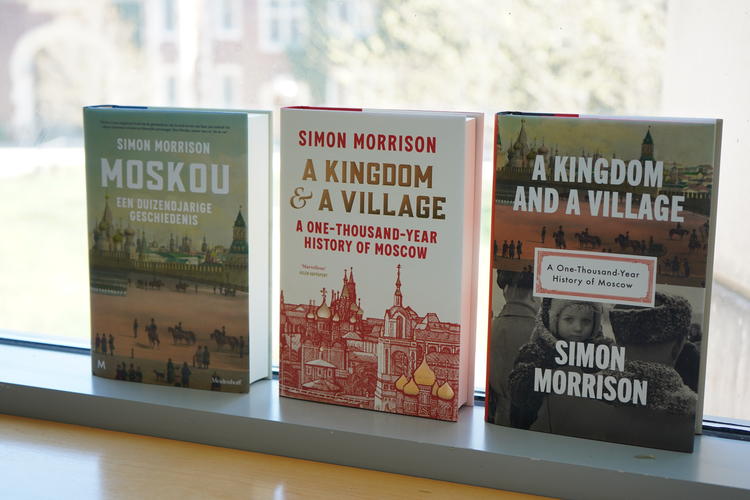
Simon Morrison (Music, Slavic Languages and Literatures, and Canadian Studies), a Princeton University music historian and scholar of Russian culture, recently published “A Kingdom and a Village: A 1,000-Year History of Moscow,” a sweeping account of the city’s evolution across a millennium. Drawing on political history, culture, and his own early experiences in the city, Morrison traces how Moscow developed into one of Europe’s most influential and contested capitals.
In a Q&A on the Department of Music website, Morrison reflected on his first encounters with Moscow, the role of music and the arts in shaping its identity, and how the city’s past continues to inform its present.
What do you hope readers can take away from your book?
Culturally, Russia is wired very differently from the West. Moscow is one of Europe’s largest cities, yet it has always been isolated. It prides itself on being a kind of civilized otherness, and I think we need to respect that perspective. It’s been through so much that it has lessons for the rest of the world—a very different perspective, neither better nor worse.
I didn’t expect to write a book like this. I just realized there was no recent history of the city in English. I am a music historian, not a historian historian, so what am I doing? But I realized that since so many political and historical documents have been destroyed, the way to understand things is through culture. Those records are preserved, and studying cultural artifacts provided information you couldn’t otherwise find.