



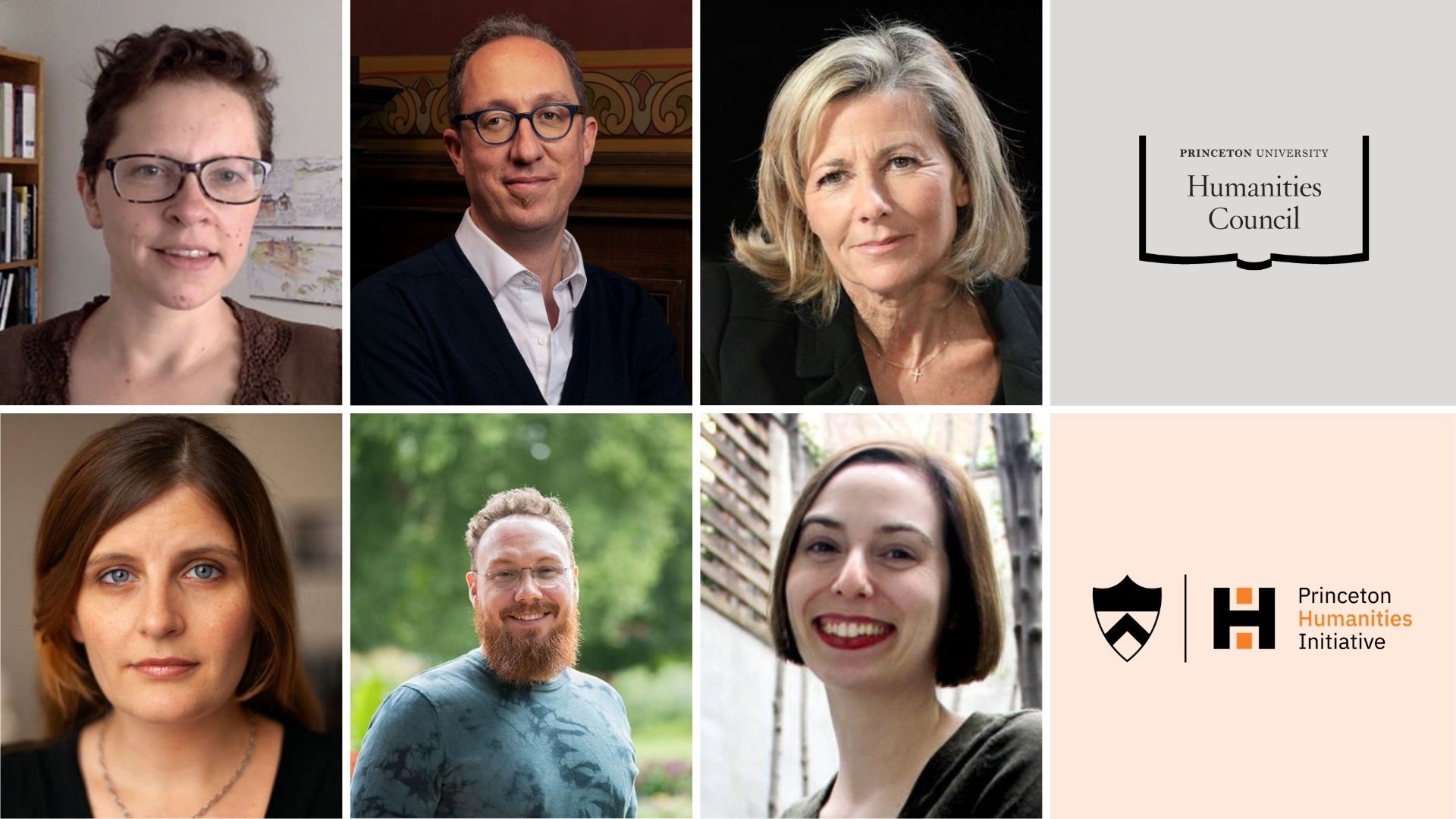
The Humanities Council and the Princeton Humanities Initiative are pleased to welcome six visiting fellows in the 2026-27 academic year. Representing a range of humanities disciplines and approaches, these scholars, writers, and practitioners will join their nominating departments on campus and contribute broadly to the University community.
The Council will host two Long-Term Visiting Fellows, each in-residence for a full semester, to teach a course and participate in the intellectual life of the University. In addition, the Council will welcome a Short-Term Visiting Fellow for a multi-day visit to Princeton to participate in class discussions, colloquia, performances, or other events across campus.
The Princeton Humanities Initiative, in partnership with the Council, will also host three inaugural Media & Meaning Fellows. These short-term visitors will spend three to five days on campus, engaging with students, faculty, and the broader public to explore the ways media of all kinds, from mass media to generative AI to the visual arts, influence our understanding of the world.
“The Humanities Council is delighted to welcome these visiting fellows to the University. Their teaching and research promise to enliven our humanities community with fresh ideas and new perspectives,” said Christina Lee (Spanish and Portuguese), acting chair of the Humanities Council. “We are especially pleased to collaborate with the Princeton Humanities Initiative, whose partnership allows us to broaden the visiting fellows program around the shared theme of Media & Meaning.
“The Humanities Initiative is thrilled to partner with the Humanities Council to welcome the inaugural cohort of Media & Meaning Visiting Fellows,” said Rachael Z. DeLue (Art & Archaeology), director of the Princeton Humanities Initiative. “We are excited for them to share their work on campus and to deepen ongoing conversations across disciplines about the ways that media of many different types shape how we understand ourselves and attribute meaning to our experiences of the world.”
A full list of fellows is below.
Long-Term Fellows
Dimitri El Murr is a professor of ancient philosophy in the Department of Philosophy at École normale supérieure – PSL in Paris, France. His research area focuses on ancient philosophy, especially Socrates, Plato, and political Platonism in antiquity and beyond. He is the author of L’Amitié (2001), a collection of texts on the philosophy of friendship, and Savoir et gouverner: Essai sur la science politique platonicienne (2014). He has edited or co-edited several publications, including La Mesure du savoir: Études sur le Théétète (2013), The Platonic Art of Philosophy (2013), Les philosophes faces au vice, de Socrate à Augustin (2020), and Kant et Platon. Lectures, confrontations, héritages (2022). He is currently working on a monograph on Plato’s theory of friendship.
In Spring 2027, El Murr will be a Class of 1932 Long-Term Visiting Fellow in the Humanities Council and Department of Philosophy. He will teach a seminar on Plato’s conception of friendship (philia), exploring central questions about Plato’s ethics, politics, and the psychology of love.
Amy Russell is associate professor of history and classics at Brown University. She is a Roman political and cultural historian, with a particular interest in architecture, urbanism, and space. She is currently working on a monograph on the building activity of the imperial Senate, part of a larger project on the contributions of multiple social groups to imperial imagery and ideology. She has also published on concepts of public and private, the relationship between English and German-language research on the Roman Republic, and the spatial turn, and has an ongoing project on scale. Her next major work will be a monograph on the institutional and cultural role of the populus Romanus, for which her preparations have included new collaborations with political scientists, historians, and lawyers on the construction of peoplehood across time and space.
Russell will serve as a Class of 1932 Long-Term Visiting Fellow in the Humanities Council and the Department of Classics in Spring 2027. She will teach the undergraduate course “The City of Rome,” which will investigate the ways in which architecture and urban planning shaped political ideas and actions in ancient Rome.
Media & Meaning Short-Term Fellows
Julie Beth Napolin is an associate professor of digital humanities at the New School. As a literary and media theorist working at the intersections of narrative and sound, she is especially interested in the history of sound reproduction, the practices and philosophies of listening, and their entanglement with race, memory, and nation. She is the co-editor of The Faulkner Journal and a member of the editorial board of Sound Studies. She has served as an officer of The William Faulkner Society, The Joseph Conrad Society of America, and the New School’s chapter of the AAUP. She is currently at work on two monographs, Stay with Me: Conversation Before and After AI, and After Images: Recitation and Listening to Violence.
Napolin will be a Media & Meaning Short-Term Visiting Fellow in the Princeton Humanities Initiative and the Department of English in Fall 2026. Her visit will also be in collaboration with the Program in European Cultural Studies. At Princeton, she will visit relevant undergraduate courses, give a public lecture and performance, as well as lead a workshop on her recent publications.
Verity Platt is a professor in the Department of Classics at Cornell University. She specializes in Greek and Roman art history, with a particular interest in the relationship between ancient literary and visual cultures in the Hellenistic and Roman periods. Her research and publications focus on ancient theories of the image, media and intermediality, and the material and visual culture of religion. She is the editor of Classical Receptions Journal and has curated exhibitions featuring the work of contemporary artists. Her latest monograph, Epistemic Impressions: Making and Mediating Classical Art and Text (2025), explores how Greek authors drew on ancient models of sense-perception when formulating relationships between texts and objects. She is currently working on several new projects, including a monograph on Pliny the Elder’s Natural History.
In Fall 2026, Platt will serve as a Media & Meaning Short-Term Visiting Fellow in the Princeton Humanities Initiative and the Department of Classics. Collaborating units include the Department of Art & Archaeology and the Princeton University Art Museum (PUAM). While at Princeton, she will lead an undergraduate course workshop, give a gallery talk at PUAM, and participate in a lunchtime work-in-progress session.
Leif Weatherby is an associate professor of German and director of digital humanities at New York University. He is also the founding director of the university’s Digital Theory Lab, which pursues theoretical insights in digital media through a hands-on and collaborative lab setting. His research focuses on literary theory, digital culture, and the history of science. He is especially interested in dialectics, semiotics, the nature of data and computing, and problems of political economy after the Industrial Revolution. He is the author of Transplanting the Metaphysical Organ: German Romanticism between Leibniz and Marx (2016), a history of the term “organ” in German Romanticism. His second monograph, Language Machines: Cultural AI and the End of Remainder Humanism, will be published in June 2025.
In Fall 2026, Weatherby will serve as a Media & Meaning Short-Term Visiting Fellow in the Princeton Humanities Initiative and the Center for Digital Humanities (CDH). His visit will be in collaboration with the Department of English and the Department of German. He will lead a workshop at Princeton’s AI Lab, give a public lecture co-organized by CDH and the Program in Media + Modernity, as well as meet with faculty and graduate students in CDH’s Modeling Culture series.
Short-Term Fellow
Claire Chazal is a French journalist, author, and television and radio host. An iconic figure in France’s broadcasting landscape, she presented the weekend news on TF1 from 1991 to 2015, where she hosted election nights and interviewed French presidents as well as prominent politicians, actors, and cultural icons. Following her tenure at TF1, she presented the cultural programs Entrée libre and Passage des arts and hosted major arts broadcasts including Le Grand Échiquier. She has received multiple honors for her contributions to journalism and French cultural life, including distinctions in the Ordre des Arts et des Lettres and the Légion d’honneur. Chazal writes a weekly cultural column, “Claire Chazal’s Cultural Week” for Le Parisien magazine.
She will be a Whitney J. Oates Short-Term Visiting Fellow in the Humanities Council and the Department of French and Italian in Fall 2026. As part of her visit, she will participate in a public conversation in French with the Francophone community in and around Princeton. Additionally, she will lead a workshop in English for students and faculty and meet with graduate students for a roundtable discussion.
The Humanities Council’s Long-Term and Short-Term Visitors are made possible with support from the Belknap Visitors in the Humanities Fund, the Class of 1932 Visiting Lectureship Fund, the David A. Gardner ’69 Magic Project, the Eberhard L. Faber Class of 1915 Memorial Lecture Fund, the Edward T. Cone ’39 Humanities Fund, the Old Dominion Fellowship Fund, the Virginia and Richard Stewart Memorial Fund, and the Whitney J. Oates Fund for Scholarship in the Humanities. For more information, visit the Humanities Council website. For more information about the Humanities Initiative’s work on Media & Meaning, visit the Humanities Initiative’s website.