






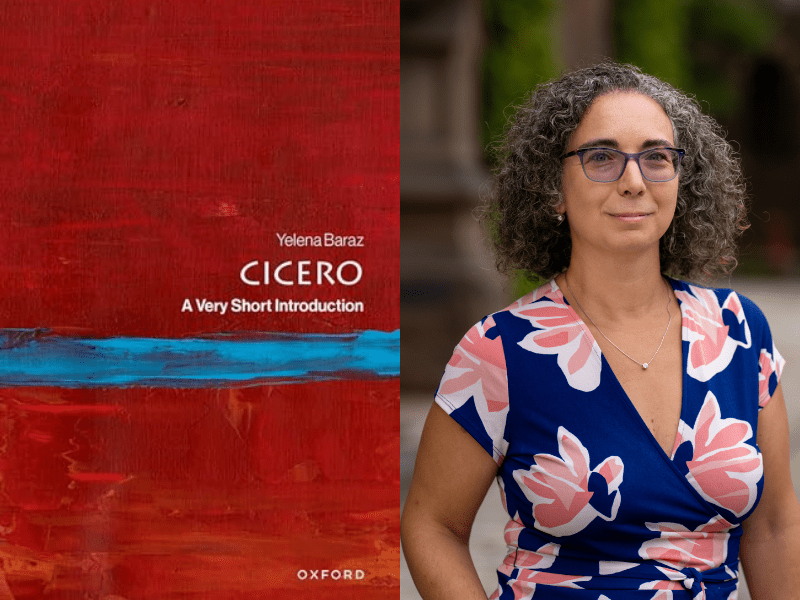
Yelena Baraz is Kennedy Foundation Professor of Latin Language and Literature and professor of classics. She is the director of the Society of Fellows in the Liberal Arts. Her latest book “Cicero: A Very Short Introduction” was published in October 2025 by Oxford University Press.
How did you get the idea for this project?
I was asked to review a proposal for a Very Short Introduction for another author in the series. It was a very good proposal, but I kept thinking about how I would approach things a bit differently and that it might be fun to do. I wrote to the editor and asked whether they would be interested in a book on Cicero for the series, and they were.
How did the project develop or change throughout the research and writing process?
The main challenge of this project was learning how to write for a general audience and how to write without footnotes. It’s a very different mode, and it took some getting used to. It was helpful to realize that this mode was somewhere between academic writing and teaching, especially teaching big topics to students in the Humanities Sequence [Interdisciplinary Approaches to Western Culture]. I also had to find a balance between narration and argument.
This book is a biography of Cicero and an overview of his output, so I tried to give the reader a sense of him as a person, the circumstances that shaped him, and the main decisions that affected the course of his life. It also argues that we should see him as someone who wanted to be a mediating figure, and that perspective applies across different areas of his life and across different genres in which he wrote.
What questions for future investigation has the project sparked?
Writing this book made me come back to Cicero, whose philosophical works were the subject of my first book, and develop some of the arguments I made there in a broader context and for a different kind of audience. It made me think that I might want to do a similar project for the general reader with a different subject at some point, but in the short term it reminded me of questions that I wanted to investigate further in Cicero. One of these will be developed in a conference paper on Cicero’s treatise On Friendship. There I am interested in questions that Cicero raises about epistemology of friendship and how change (aging, different circumstances, etc.) affects friendships.
Why should people read this book?
If they are interested in Cicero, it is in fact a VERY short introduction that covers all the important facets of his life and career. Cicero is also a person from Ancient Rome we know the most about and he was active in many different spheres of Roman life, so through him there is also an introduction to Roman politics, oratory, philosophy, poetry, and personal networks among the elite.
Learn more about other publications by Princeton University faculty in the humanities by exploring our Faculty Bookshelf.