




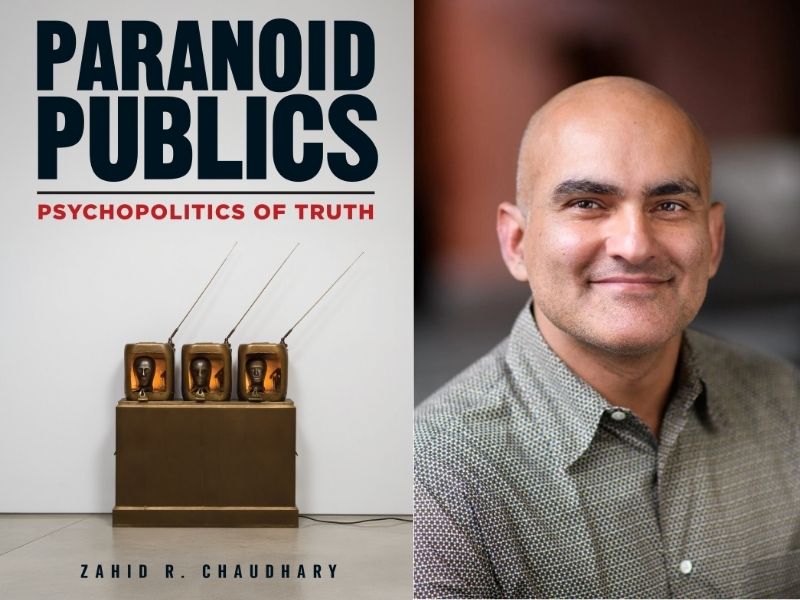
Zahid R. Chaudhary is an associate professor in the Department of English and the interim director of the Program in South Asian Studies. His latest book “Paranoid Publics: Psychopolitics of Truth” was published in November 2025 by Fordham University Press.
How did you get the idea for this project?
An invitation from The English Institute in 2018 to lecture on the topic of “Truth-Telling” was the first opportunity I had to start writing about the alarming diminishment of truth in contemporary cultural politics. I became so involved in the topic, and as the political landscape in the US and Europe became increasingly authoritarian, I decided to set aside a book I was researching on postcolonial countries, and turned my attention completely to this book focused largely (but not exclusively) on the US. The reigning explanations for assaults on truth had imputed the phenomenon to the influence of social media and/or the deleterious effects of social and economic policy. These explanations seemed incomplete to me, since they did not account for the emotional magnetism at the heart of a new and emerging politics of truth. This account is what Paranoid Publics aims to provide.
How did the project develop or change throughout the research and writing process?
The project that became Paranoid Publics evolved significantly over the course of research and writing. It began as an effort to understand discrete instances of conspiracy thinking and political denial but expanded into a broader inquiry into the psychopolitical conditions that shape contemporary public life. As the research progressed, it became clear that these phenomena could not be adequately explained through political or media analysis alone; they required sustained engagement with psychoanalytic concepts and humanities-based interpretive methods. At first, paranoia was not a dominant concern for this book, but as I did research on QAnon, anti-vaxx movements, parental rights advocacy, and election denialism, it became clear that paranoia is more than a mere characteristic these phenomena have in common—it is a conceptual backbone for understanding a new kind of politics. These forms of politics permit themselves all manner of aggression to persecute the people or institutions that they claim to be persecuted by.
Writing during a period marked by escalating public-health crises, democratic instability, and cultural polarization further sharpened the project’s focus, as I sought to address how emotional investments, fantasy, and denial operate at the level of publics rather than individuals. As a result, the book developed into a more ambitious, synthetic account of how unconscious forces structure collective relations to truth, authority, and reality in the present moment.
What questions for future investigation has the project sparked?
One key question concerns how forms of paranoid public life vary outside Euro-American settings and how colonial, racial, and geopolitical histories shape collective relations to truth and authority. The book also raises questions about the role of digital infrastructures—such as social media algorithms and platform economies—in amplifying or transforming unconscious social dynamics, suggesting the need for further interdisciplinary work at the intersection of psychoanalysis, technology studies, and political theory. Additionally, the project invites inquiry into whether and how alternative public formations might resist paranoid structures, including the possibilities for reparative politics, solidarity, or democratic renewal. Finally, it prompts reflection on the limits of psychoanalytic interpretation itself: what other humanities methodologies might complement or challenge psychopolitical analysis in understanding contemporary crises of belief, knowledge, and collective life?
Why should people read this book?
At a moment when conspiracy theories, misinformation, and hostility toward expertise shape politics and culture, Paranoid Publics moves beyond surface explanations to examine the emotional and unconscious forces that organize collective beliefs. Rather than dismissing such phenomena as irrational or fringe, I have aimed to show why they are compelling, how they take hold, and what they reveal about shared anxieties around truth, authority, and belonging. The book equips readers with conceptual tools to think more clearly about public-health resistance, election denialism, and polarized media environments, while also modeling how humanities-based analysis can illuminate urgent social problems. Paranoid Publics invites readers to better understand the world they inhabit—and to reflect on their own participation in contemporary public life.
Learn more about other publications by Princeton University faculty in the humanities by exploring our Faculty Bookshelf.