



This Q&A series highlights the work of the Humanities Council’s current Old Dominion Research Professors. The professorship provides Princeton faculty with additional research time while strengthening the University’s broader humanities community. Throughout the academic year, Old Dominion Research Professors engage in and contribute to the intellectual life of the Humanities Council and serve as Faculty Fellows in the Society of Fellows in the Liberal Arts.
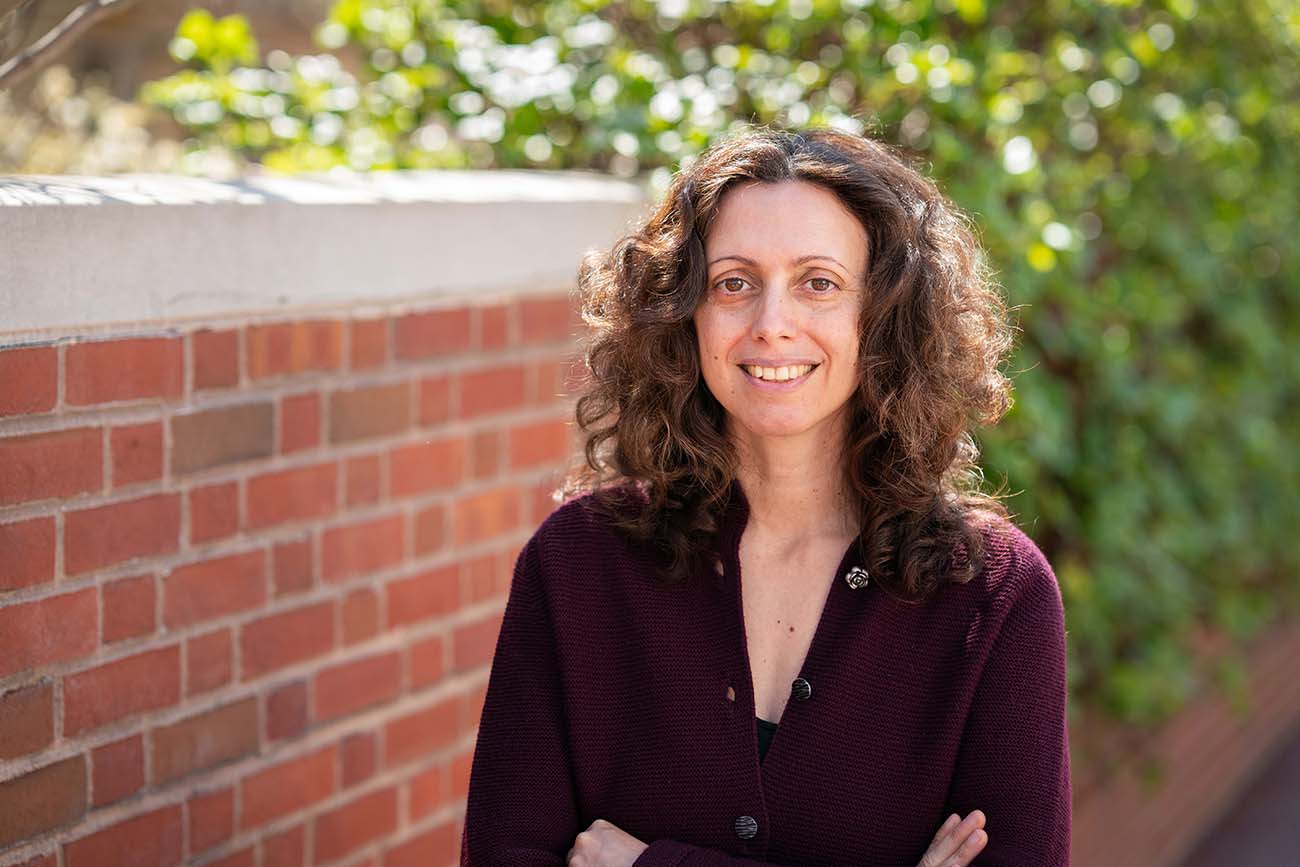
This year, as a 2025-26 Old Dominion Research Professor in the Humanities Council, Elena Fratto (Slavic Languages and Literatures) is working on a book project titled “Metabolic Modernities,” which investigates the concept of metabolism as energy transformation in Russophone literature and culture at the turn of the 20th century.
Tell us why you chose your current research topic.
My research offers novel interpretive avenues into canonical texts of Russophone literature by drawing on the Health and Environmental Humanities. My first book, “Medical Storyworlds,” examined the narrative structure of medical knowledge. The deeper I investigated the intersection of health discourse and theories of narrative, the more obvious it became that the porosity of the human body and its enmeshment with the surrounding environment—physical environment, but also economic models, value systems, global logistics, and the circulation networks of goods, people, and knowledge—deserved more than just my peripheral attention.
In my current book manuscript, “Metabolic Modernities: Energy Transformations and Body Ecologies in Russophone Literature and Culture of the 1920s,” the concept of “metabolism,” in the original, nineteenth-century connotation of exchange of matter among the animal, vegetable, and mineral kingdoms, has become a privileged metaphor and a working category to trace and analyze bodies, texts, and the making and unmaking of the world. I offer new readings of literary works and cultural artifacts produced in the first Soviet decade from an Energy Humanities and Food Studies perspective by emphasizing organicist tropes in a period that is traditionally understood as informed by a mechanistic paradigm.
Pre-Revolutionary models for energy transformations across the human-nonhuman divide continued to inform the style and worldview of Soviet writers well beyond 1917, despite a state agenda that set out to control the economy, the environment, and individual and collective bodies. Authors such as Alexander Beliaev, Viktor Shklovskii, Yuri Olesha, Evgeny Zamiatin, and Andrei Platonov are not only informed by pre-Revolutionary theories, but they also anticipate concepts and models in ecological thought that would be fully formulated decades later. Furthermore, my project prompts us to view the October Revolution itself as a metabolic process on a vast scale, through which the old is disassembled, processed, and reassembled to be repurposed into a new Soviet Weltanschauung, in which, under close examination, the earlier aesthetic threads shine.
What do you hope that this research will add to your field?
“Metabolic Modernities” contributes to existing scholarship in my field that argues for continuity in Russian culture, aesthetics, and history of ideas across the 1917 watershed, complicating the notion that the October Revolution brought about a caesura with the past. Yet, it engages these questions from a novel perspective, one that draws upon Russophone literary texts, scientific theories, and planetary models side by side, and that situates my literary inquiry within the field of Environmental Humanities, especially the Energy Humanities and Food Studies.
Through this framework, my research proposes fresh interpretive avenues into literary texts and films of the 1920s that are well known in our field. The authors I analyze parse the new order of things, strive to find their role in it, and question the state narrative about the role of humankind and human activity in the world. Their preoccupation with the human-environment nexus, articulated in a poetics that is rooted in organicist and metabolic imagery, remains an understudied aspect of their resistance to Soviet ideologies.
What’s one thing about your current project that you think would interest the public?
By examining metabolic exchanges between the human body and the environment in literature and the arts of the long 1920s, this book connects the early Soviet era with both pre-Revolutionary traditions and an interdisciplinary present. It brings new voices to contemporary Environmental Humanities debates, which are still overwhelmingly Anglophone. Besides the fun in discovering some visionary speculative fiction and timeless masterpieces of the Soviet 1920s, general educated readers may enjoy tracing foundational concepts of the modern Environmental Humanities, including the Anthropocene, the biosphere, and systems theory, back to the early-twentieth century Russophone tradition.
Tell us about your year as an Old Dominion Research Professor.
An in-residence leave puts me in the privileged position of taking full advantage of the rich intellectual life and the community on campus while I tend to my own writing. There are so many excellent initiatives, conferences, resources that there is no time to enjoy when one teaches full time. This year I have been attending more lectures and meeting more often with colleagues and visiting scholars to exchange ideas and ignite new collaborative research and pedagogical projects. This is invaluable. I also have more time to attend PU concerts, use the practice rooms in the Music Department between writing sessions to get my brain reorganized, and participate in guided nature walks around campus and the Institute for Advanced Study.
Are there any memorable humanities events that you’ve attended this year?
The weekly gatherings at the Society of Fellows have been delightful opportunities for learning and sharing ideas in a highly interdisciplinary group of bright and generous scholars.
The highlight of the academic year for me as an Old Dominion professor was the Humanities Colloquium last September. The Humanities Council has provided me with an exceptional, collegial, and enjoyable intellectual community since I joined Princeton in 2016. It was an honor to offer my remarks on “timeliness” in the humanities at the Colloquium by drawing on my current research, to listen to the talks delivered by more seasoned colleagues, and to join the lively discussion with the intellectually stimulating scholars who gravitate around the Council.
Is there any other piece of your work that you’d like to highlight?
Articles from the book manuscript in-progress have appeared in a recent special issue of The Russian Review that I co-edited with Riccardo Nicolosi of LMU-Munich, and in the Russian-language journal New Literary Observer. One is forthcoming in the inaugural issue of The Anthropocene Review, a new journal by Duke University Press. Since 2021 I have been co-PI on a multi-year collaborative research project with Columbia University that maps and examines vaccine hesitancy in different communities with the help of digital humanities tools.
Other current research interests of mine are Oil Rocks, an oil rig city in Azerbaijan, as well as the environmental impact and medical valence of lithium, as staged and articulated in Ukrainian cultural artifacts.