






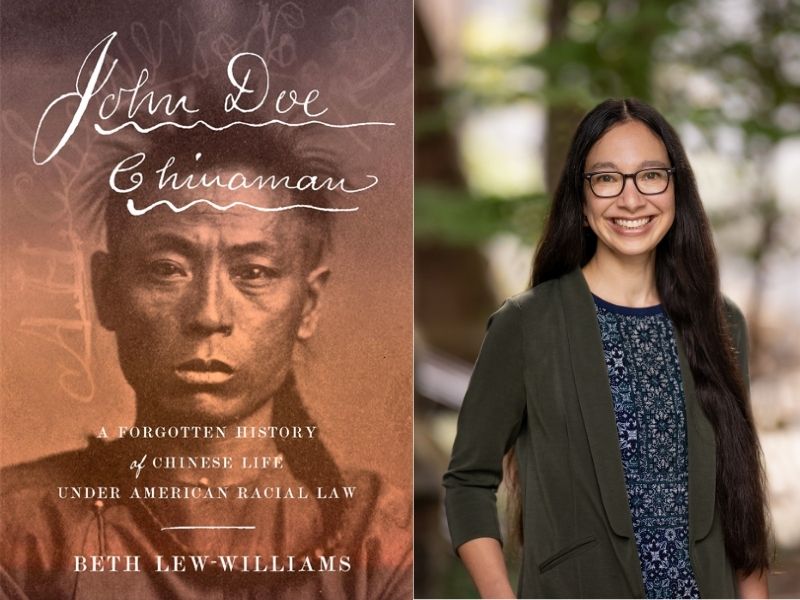
Beth Lew-Williams is a professor in the Department of History and the director of the Effron Center’s Program in Asian American Studies. Her latest book “John Doe Chinaman: The Forgotten History of Chinese Lives under American Racial Law” was published in September 2025 by Harvard University Press.
How did you get the idea for this project?
I have been studying the early history of Chinese in America for two decades. I know the traditional narrative well: It begins with the arrival of tens of thousands of Chinese migrants in the gold fields of California, then follows the virulent mix of racism and nativism that met them and finally culminates in the passage of the Chinese Exclusion Act in 1882. It is a story about unwanted immigrants and the landmark immigration law developed to keep them out. The traditional narrative is true, but it is far from complete.
I wrote John Doe Chinaman to look beyond the infamous Chinese Exclusion Act, the power of the federal government, and the moment of border crossing. I set aside (centralized and often digitized) federal records in favor of driving to dozens of local historical societies, courthouses, and county archives across California, Oregon, and Washington. What I found was that state and local governments enacted about five thousand laws that marginalized and controlled Chinese residents between 1850-1920. These laws regulated everything from healthcare to education, property ownership, business formation, and kinship customs. Some mirrored Jim Crow laws, but many others were specifically tailored to the Chinese.
How did the project develop or change throughout the research and writing process?
I have always been deeply invested in recovering the stories of everyday people. I think it’s important to write about that time when a tax collector visited the Chinese barber and threatened to cut his queue, or that time when Ruby Tsang went to the theater and attempted to sit down. Life is made up of messy moments and chance encounters, and storytelling is essential to capturing these complex dynamics.
But while writing this book, I started working with Hannah Postel, who was a Princeton graduate student and is now an Assistant Professor of Public Policy at Duke. She introduced me to more quantitative methods and together we launched a project to identify, count, and categorize anti-Chinese laws. I never would have understood the extent of anti-Chinese laws without big data methods, and I look forward to publishing an article that describes our collaboration.
Why should people read this book?
My book starts with the little-known fact that the Chinese faced thousands of discriminatory laws, but it does not end there. I propose a new framework to comprehend these anti-Chinese laws and unearth a decades-long Chinese struggle against them. The result, I hope, is a new and unexpected history of American racial law.
Learn more about other publications by Princeton University faculty in the humanities by exploring our Faculty Bookshelf.