




By C. Luke Soucy and Mary Cate Connors
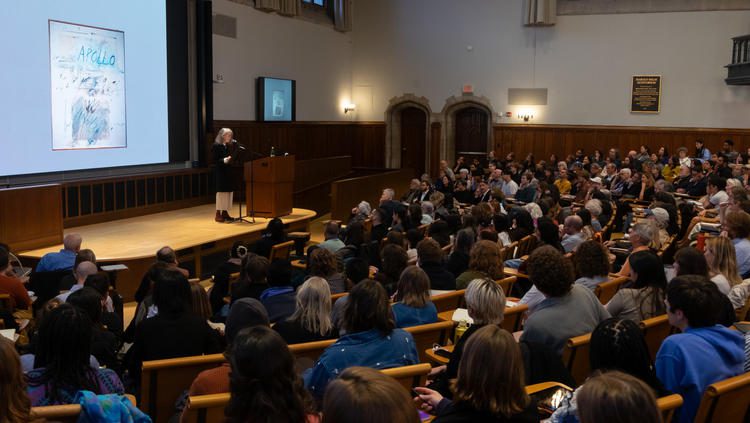
Over 400 university and community members packed the house on Tuesday, November 4 to hear poet, translator, and classicist Anne Carson deliver the annual Robert Fagles Lecture for Classics in the Contemporary Arts. Carson’s presentation, titled “Beware the man whose handwriting sways like a reed in the wind,” mixed memoir, classical translation, art criticism, boxing exhibition, and performance art in a deeply personal meditation on life and death in the wake of her diagnosis with Parkinson’s disease.
One of the world’s most eminent living writers, Carson is well-known for the pithy biographical note that accompanies most of her books: “Anne Carson was born in Canada and teaches Ancient Greek for a living.” Her many publications range from scholarship and criticism to poetry and translation, including the groundbreaking study Eros the Bittersweet, the bestselling verse novel Autobiography of Red, and the recent poetry collection Wrong Norma. Previously a professor of classics at Princeton, she has since made a career teaching at universities around the world as, in her words, “a visiting whatever.”
“Carson’s style [is] spare, it is precise, it is dense with meaning, and it is also, in some difficult to define way, funny,” said Josh Billings, chair of the Department of Classics, in his introduction to the event. “Her work, though largely not taking the form of traditional scholarship … has done more than almost anyone alive in generating new ideas about the ancient world, and in bringing new readers and audiences to it.”
The Carson style was on full display in her lecture, which opened with a translation of Catullus 46 and ended with a ten-second audience group scream. The event’s title, drawn from Confucius, refers to Carson’s experience seeing her own handwriting deteriorate since her diagnosis. She also returned throughout the talk to Roland Barthes’ question, “How to draw a line that is not stupid,” pairing the mantra with images of artwork by Cy Twombly.
In a particularly memorable section, Carson discussed her ongoing practice of using boxing as a form of therapy for Parkinson’s. Donning black boxing gloves with the assistance of her husband and co-performer, artist Robert Currie, she demonstrated her form by jabbing and swiping through the air—to cheers from the audience.
“In my boxing class,” said Carson, who had earlier compared death to a black doorway, “I observe that it is all but impossible, when someone else is putting a glove on your hand, to conjure up or worry about the black doorway.”
Carson’s visit logged a new high-water mark for the Fagles Lecture, now in its eighth year. Established in memory of classical translator and Princeton professor Robert Fagles, the annual event brings to Princeton distinguished artists whose work engages with classical studies. Since the inaugural 2017 lecture by poet Alice Oswald, the series has featured poets Ishion Hutchinson and A.E. Stallings, novelist Kamila Shamsie, translator Daniel Mendelsohn, and playwrights Mary Zimmerman and Luis Alfaro.

Like all Fagles lecturers before her, Carson complemented her public talk by teaching a special session of the undergraduate Humanities Sequence course “Interdisciplinary Approaches to Western Culture,” whose students read Carson’s celebrated Sappho translations, If Not, Winter (2002) as part of their syllabus. Carson’s lesson plan involved dividing class attendees into small groups and asking them to leave the classroom for ten minutes in search of a “border,” physical or otherwise, they could then “redefine.”
After mulling over their individual version of borders, each group then presented or performed their interpretation for the class. One group brought a pile of fallen leaves indoors, breaching the boundary of inside and outside; another presented from the back of the classroom instead of the front, reconceptualizing the traditional bounds of the academic setting. At the conclusion of the exercise, Carson and Currie gave students their email addresses, assigning them all to “make something” that illustrated their presentation and send it to them directly.

In a short question-and-answer session after the activity, students asked Carson about her definition of a successful career (“I’d be happy with the story as is, just in my notebook”), her approach to translation (“plainness and exactitude”) and the author she would recommend anyone in the room to read (“Homer—learn Greek and read Homer”).
The public lecture audience was similarly keen for wisdom, as Carson’s remarks linked the struggle for perfection in art with that against death and degenerative illness. When one audience member asked her to comment on her work’s tendency to fight against its own formal conventions, Carson extended her still-gloved hands and replied, “That’s the great thing about forms—the form fights back!”
So does Anne Carson.
Support for the Fagles Lectureship is provided by the Departments of Classics and Comparative Literature, the Humanities Council, Princeton University Public Lectures Committee, Program in Humanistic Studies and the Seeger Center for Hellenic Studies.
This piece was originally published on the Department of Classics website.