





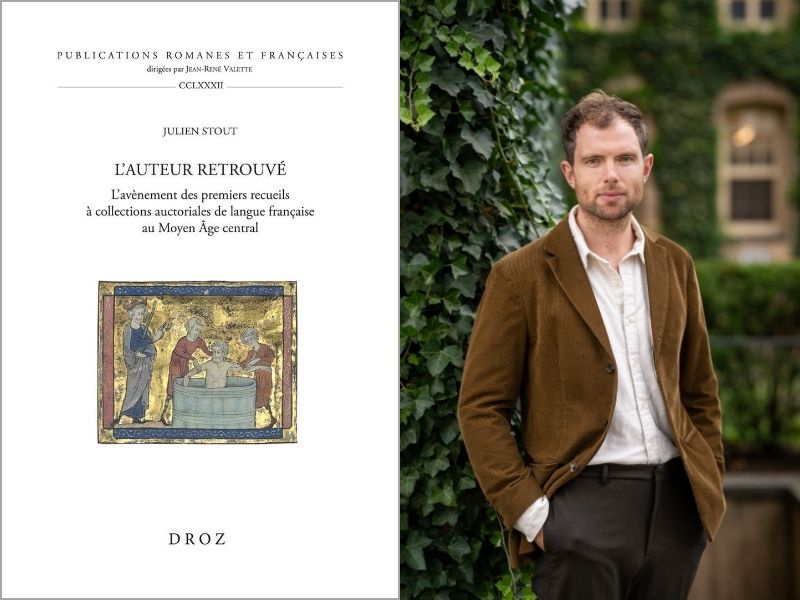
Julien Stout is an assistant professor of French and Italian. His latest book “L’auteur retrouvé. L’avènement des premiers recueils à collections auctoriales de langue française au Moyen Âge central” was published in June 2025 by Droz.
How did you get the idea for this project?
This book originates from my doctoral research, conducted as part of an international project on manuscripts containing Old French fabliaux—short narratives from the 13th and 14th centuries, often blasphemous and sexually explicit. My initial role within this larger research team was to examine a select group of manuscripts in which the fabliaux were arranged by author. This author-centered organization struck me as significant because it was highly unusual for that era: most medieval manuscripts of Old French literature are structured by genre or theme, and the majority of Old French poems circulated anonymously. My goal was to understand why and how the author had emerged as a structuring concept within the fabliaux manuscript tradition—a question that resonates with the modern aesthetic and legal frameworks in which authorship and intellectual property have become foundational.
How did the project develop or change throughout the research and writing process?
As I gathered data and consulted with experts, two fundamental challenges emerged: one concerning scale and scope, the other, methodology.
On scale and scope: The fabliaux were provocative and entertaining, and they ultimately played a key role in shaping my final thesis. Yet it soon became clear that focusing exclusively on them was too limiting.
Authors in my initial corpus—like the well-known Rutebeuf, whose autobiographical poetry would later inspire Joan Baez—had composed extensively in other genres, including some largely overlooked by modern critics, such as saints’ lives written about women. It became clear that, in order to truly understand the emergence of authorship in Old French manuscript culture in the High Middle Ages (ca. 1100-1340), I needed to look beyond a single genre.
Earlier studies on the rise of Old French authorship often relied on a similarly narrow—though generically more varied—selection of texts. To avoid reproducing this limitation, I adopted a more comprehensive approach: surveying the manuscript tradition of approximately 300 Old French authors listed in the indexes of Medieval Literature. From this survey, I constructed a corpus of 25 manuscripts containing authorial collections of 17 poets, studied in parallel with the foundational corpus of troubadour (Old Occitan) and trouvère (Old French) “chansonniers.” This broader foundation yielded a more nuanced and diversified perspective on the “birth of the French author.”
On methodology: As I began working through this newly assembled corpus, I found that prevailing accounts of the emergence of French authorial figures were often inadequate. When scholars hadn’t simply “moved on” from the question—deeming it irrelevant to the medieval period or already settled—they tended to frame the rise of the French author within triumphalist narratives of modernity, subjectivity, and individualism. Yet these concepts—shaped largely by post-Enlightenment thought from Kant to Hegel—have little in common with medieval conceptions of authorship.
The figure of the medieval French author, as it emerged in the manuscripts I studied, was not so much an expression of individual subjectivity as a collective construction. Patronesses, scribes, and audiences played an active role in shaping and publicizing authorial identity within a rapidly growing French-language book market.
To make sense of this, I turned to what Alastair Minnis calls the “medieval theory of authorship”—a framework centered on the auctor, a figure like Augustine, Virgil, or King Solomon, who transmitted collective truth with authoritative weight, often within the medieval Latin learned culture. What I found in my corpus, however, was a playful and often subversive dismantling of this model.
This deconstruction seemed to be a distinctly French phenomenon: in the Old Occitan tradition, the troubadours had been deemed worthy of becoming vernacular auctores. But not the French authors being fashioned in the manuscripts I studied: they appeared not as solemn conveyors of truth, but as self-deprecating, even comic figures—authors portrayed above all as sinners.
Importantly, though its numerically marginal status in a sea of anonymity indicates that it wasn’t necessarily popular or well accepted, this sin-centered portrayal of authorship was not a proto-modern rejection of meaning or authority. Rather, it was deeply pious. By rejecting the lofty role of the auctor and embracing the figure of the flawed poet, these manuscripts affirmed a theological logic: that only God is the true author of truth, and that human beings can claim authorship only of their sins—transformed, in this case, into poetry.
In the end, this methodological journey brought me full circle. The provocative, irreverent tone of the fabliaux was an expression of a broader, theological reimagining of what it meant to be an author in the medieval Francophone world.
What questions for future investigation has the project sparked?
After completing this book, I came to realize that authorship is an inexhaustible and profoundly generative subject. I am still eager to explore how the connections between authorship, theodicy, free will, and sin were reconfigured in 13th-century vernacular culture.
I also remain preoccupied by questions left unresolved: Why are the celebrated—and, at times, deconstructed—authorial figures in these manuscripts invariably male? What role does music play in this dynamic, particularly the melodies attached to certain authors’ works in specific manuscripts?
Finally, I would like to return to individual figures in greater depth. One such figure is Adenet le Roi, whose works include extraordinary narratives of African kings and mechanical marvels—among them, a metal archer fashioned by Vergil himself, inscribed with a mysterious Hebrew text. Adenet’s case alone—whose name is potentially reminiscent of Adonai (אֲדֹנָי) and who seems to mimic God’s work—warrants much more attention.
Why should people read this book?
This book is intended primarily for medievalists seeking to challenge established assumptions about vernacular authorship and to reconsider the specificity of the “birth of the French author” within broader medieval conversations on authorship.
It also speaks to readers interested in the longer history of authorship—those wishing to approach contemporary debates on copyright, generative AI, or the #MeToo movement surrounding writers and directors from a different perspective. Rather than tracing a strictly genealogical or causal trajectory, the book offers a historically grounded meditation on what authorship once meant to people whose worldviews differed profoundly from our own, and on the kinds of questions they posed—questions we no longer ask, or that survive only at the margins of contemporary discourse.
Although substantial, the book need not be read in a linear fashion: it is designed to support both selective consultation and sustained engagement.
Learn more about other publications by Princeton University faculty in the humanities by exploring our Faculty Bookshelf.