




The Aesthetics of Singularity: A Gauss Seminar on Fredric Jameson
October 3, 2025 · 1:00 pm—6:00 pm · Betts Auditorium
Humanities Council


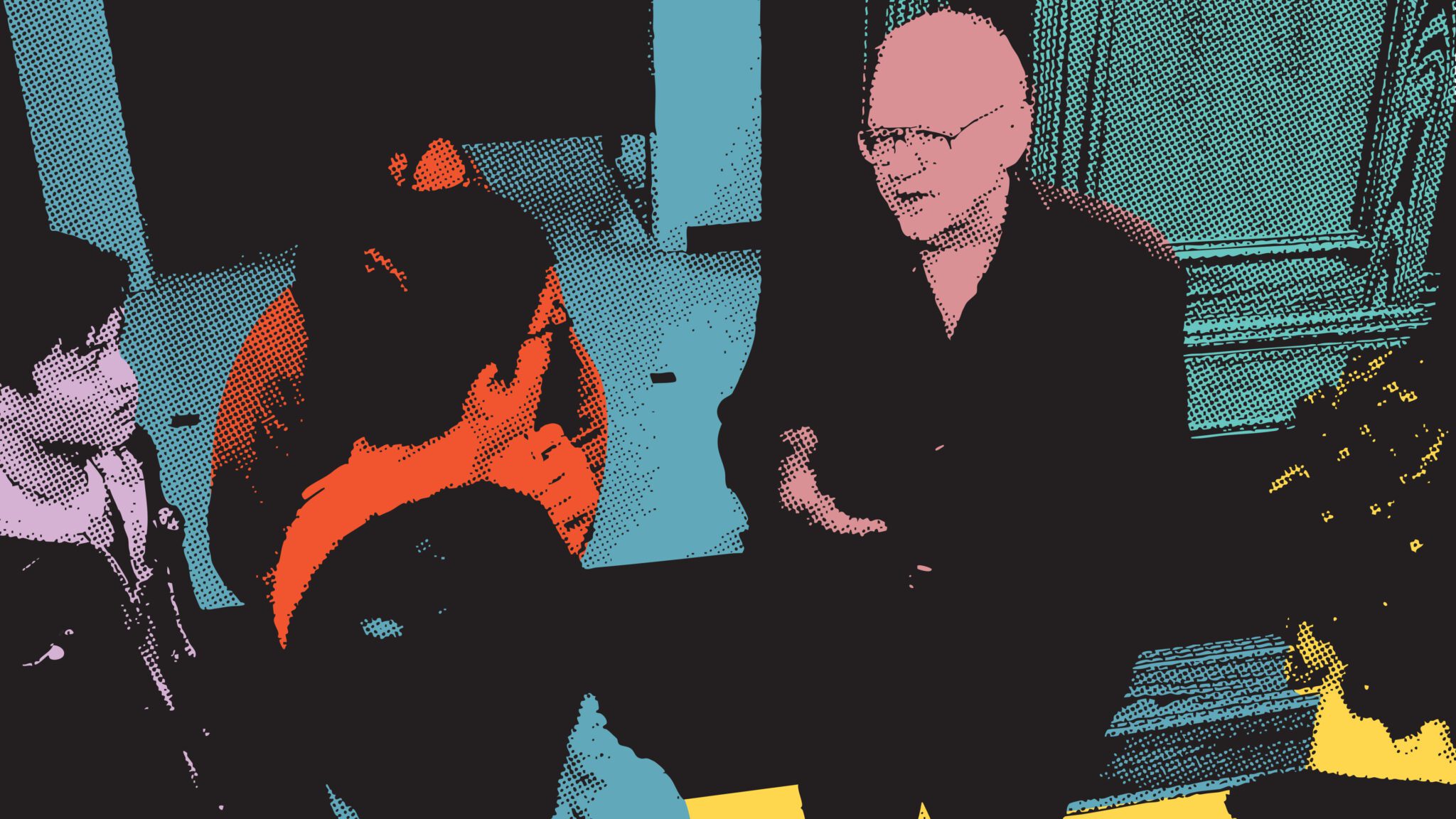
Fredric Jameson transformed thinking across all the humanities, most of the social sciences, fields such as architecture and legal theory, and even some physical sciences. This daylong seminar gathers scholars and theorists to explore the significance of Jameson’s work today—and what it might mean for the future of critical thought.
Speakers include:
- Andrew Cole, Princeton University
- Hal Foster, Princeton University
- Alexander R. Galloway, New York University
- Ranjana Khanna, John Hope Franklin Humanities Institute; Duke University
- Lisa Lowe, Yale University
- Neferti X. M. Tadiar, Barnard College, Columbia University
Open to the public. Organized by Brooke Holmes and Andrew Cole.
Schedule:
1:00–1:10 pm — Introductions
Christina Lee
Professor of Spanish and Portuguese; Acting Chair of the Humanities Council
Princeton University
Brooke Holmes
Susan Dod Brown Professor of Classics; Director, Gauss Seminars in Criticism
Princeton University
1:10–2:40 pm — Panel 1: Form and Marxism
“Jameson and the Question of Style”
Ranjana Khanna
Professor of English, Women’s Studies, and the Literature Program; Director, John Hope Franklin Humanities Institute
Duke University
In his 1984 afterword to his first book, Sartre: The Origins of a Style, Jameson writes of what style meant for him. The book in its form as a dissertation was supervised by Erich Auerbach, and Jameson notes that early formation as well as the importance of Leo Spitzer, Jean-Pierre Richard, and a reading technique shaped by Sartre himself. But very soon after, Jameson’s attention to style shifts.
The talk will address his use of the term style, its relation to literary forms like narrative and form, but also his tracing of style as symptom of something else, his development of style in relation to sensation, the signature, singularity, modernism, and species-being. Through a reading of the changing nature of attention to style, we can see how he brings together semiotics and dialectics to understand the seeds of time.
“Cultural Revolution?”
Hal Foster
Townsend Martin, Class of 1917, Professor of Art and Archaeology
Princeton University
Fredric Jameson is often credited (or charged) with the saying that it is easier for us to imagine the end of the world than the end of capitalism, but in fact his dialectic runs counter to such fatalism. Frequently he paints a very dark picture of capitalism as a universal prison, only suddenly to tunnel under it in a conceptual breakout (like the proverbial old mole on speed). Usually, his dialectic contains a ray of light. At the same time the Jamesonian dialectic undercuts the present more often than it projects alternatives to it. Take his ambiguous notion of “cultural revolution” …
“Imperialism and Cultural Revolution”
Neferti X. M. Tadiar
Professor of Women’s, Gender & Sexuality Studies
Barnard College
In this talk, I reflect on Fredric Jameson’s thinking on imperialism as a theoretical and historical development with important bearing for our own moment. How might the relation of imperialism to late capitalism, as the object and context of his thought, and his understanding of cultural revolution, as the ultimate horizon of political and historical interpretation, inform an understanding of our own present conditions of life and work?
2:40–3:20 pm — Panel 1 Discussion and Q&A
3:20–3:40 pm — Coffee Break
3:40–5:10 pm — Panel 2: Jameson and Method
“The Future Subject of Fredric Jameson”
Andrew Cole
Woodrow Wilson Professor of Literature
Princeton University
Fredric Jameson never proposed, not directly in any case nor in one extended exposition, his own version of the subject (or subjectivity). He was far more interested in critiquing what he called “theories of the subject” in the twentieth century. Yet taking account of most everything he has written, we can indeed discover his model of the “subject” and clearly see that it has less to do with Marx, Lacan, et al. and more to do with Science Fiction, his abiding interest. The Jamesonian subject is like none other in contemporary critical theory and has immense transformative potential for the way we perceive and think about the world.
“Jameson’s Lacan”
Alexander R. Galloway
Professor of Media, Culture, and Communication
New York University
Although being influenced by psychoanalysis, Fredric Jameson never wrote a book on Jacques Lacan. Yet it is possible to reconstruct what such a volume might have looked like, based on a handful of essays written by Jameson during his career, plus the audio recordings of his 2000 seminar at Duke University devoted to Lacan. This lecture focuses on two topics in particular that characterize Jameson’s unique interpretation of Lacan. First, Jameson defined the Real as history, deviating from more conventional definitions of the term. Second, Jameson stressed a fundamental dualism in Lacan’s work, a preference for dualism also evident in Jameson’s work overall.
“Loss and Return of History and the Colonial Unpast”
Lisa Lowe
Samuel Knight Professor of American Studies
Yale University
Fredric Jameson famously characterized the cultural logic of late capitalism as the weakening of historicity and collective memory of the past, the shrinkage of time, an absence of historical depth, and the empty mimicry of past cultural forms. A sense of history is replaced by the sensationalisms of the present, immersion in commodity culture, and seduction by emptied-out stylizations – aesthetic, political, and economic. The loss of history resembles schizophrenia, which following Lacan, Jameson elaborates as the breakdown of the signifying chain that separates material signifiers in the present from their syntagmatic relation to the past, or the inability to access material and to put it into a temporality of relation. There is every reason to rue, as Jameson does, this collective loss of history and meaning, yet the response has sometimes been to call for a “return of history” that entails a return to “historicism” as method – or traditional forms of understanding the past that might include narrative, empirical and hermeneutic investigations to uncover the historical past as suppressed by ideology. This talk cautions against the collapse of a distinction between the recovery of suppressed history and “the unpast,” or catastrophic material uncaptured by time and tense, and offers a set of distinctions from psychoanalysis and the history of colonialisms that may contribute to making this distinction and impede their conflation.
5:10–5:50 pm — Panel 2 Discussion and Q&A
5:50–6:00 pm — Concluding Remarks
Andrew Cole
Woodrow Wilson Professor of Literature
Princeton University
Instituted in 1949 in honor of Dean Christian Gauss, the Seminars provide a forum for discussion, study, and the exchange of ideas in the humanities. For more information, visit the Gauss Seminars in Criticism page on the Humanities Council website.