



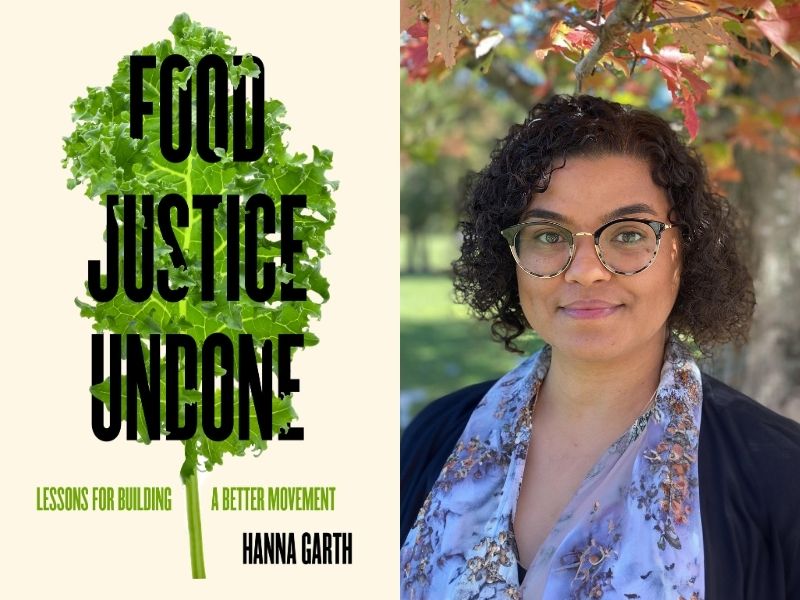
Hanna Garth is an assistant professor in the Department of Anthropology. Her book, “Food Justice Undone: Lessons for Building a Better Movement” was published in February 2026 by the University of California Press.
How did you get the idea for this project?
When I was in graduate school at UCLA I found myself longing for the garden. I grew up in the Midwest with vegetable and flower gardens, and something about the long hours of sitting that graduate school required pulled me back to the site of the garden. I longed to have my hands in the soil and use my body and mind in different ways. I lived in an apartment with manicured landscaping where gardening was not allowed. Following my desire to garden, I found myself volunteering with organizations that were engaged in food justice in South Central Los Angeles.
This did not start as a research project. But from the very beginning, while I was volunteering, I noticed an odd racial dynamic in the movement. I realized that I was most often surrounded by white folks who were coming into South Central, a majority Black and Latine community, from middle or upper-class parts of LA to “bring justice” to South LA. Initially, I had expected to find residents engaged in a grassroots struggle to improve their food system—but where were they? Why were there so many outsiders doing this work in South Central? Those early observations eventually coalesced in a set of research questions about multiracial coalition building, the meanings of justice, race and whiteness, power, and what it means to build a social movement.
How did the project develop or change throughout the research and writing process?
The project changed pretty drastically over time. While I had initially thought I would be studying a grassroots social movement led by residents of South Central, I found myself studying a set of outsiders who were coming in to South LA to change it. I had to pivot the frameworks I was using. I ended up needing to focus more on race, racial capitalism, and whiteness to really understand what was going on in this movement. Eventually I realized that I really needed to turn a critical lens on my interlocutors, something that anthropologists rarely do. But I felt the need to align with the South Central community and the many long-standing organizations that were engaging in grassroots work that was overshadowed and co-opted by these outsiders who were my research participants. That meant a radical shift in how I write about the movement, including the need to think critically about the tone of the writing. I hope that the book will be read by students, scholars, and activists of all sorts, so I wanted to write in such a way that they were called in to the work rather than just feeling called out.
What questions for future investigation has the project sparked?
Much of what I found was that outsider activists based their work on false, often racist assumptions about South Central residents. Their assumptions didn’t square with my own experiences with friends, extended family, and in-laws who live in the area. My experiences in the area were structured around commensality, care, and gatherings centered around good food and good company. But I felt the need to more systematically study that. So, I received a community-engaged research grant from the Wenner-Gren Foundation to study food consumption and acquisition in South Central households. While there are a few glimpses into household life in this book, the 35 families that I studied will form the basis for my next book.
Why should people read this book?
Anyone who wants to do something to help others, who thinks we need to be coming together to fight injustice and make the world a better place, needs to read this book. By showing the many problems with the food justice movement in South Central, it offers important lessons for future social justice work. In particular, I hope that our students, as the next generation of activists, will read it.
Learn more about other publications by Princeton University faculty in the humanities by exploring our Faculty Bookshelf.