



This Q&A series highlights the work of the Humanities Council’s current Old Dominion Research Professors. The professorship provides additional research time for Princeton faculty members and seeks to enhance the University humanities community more broadly.
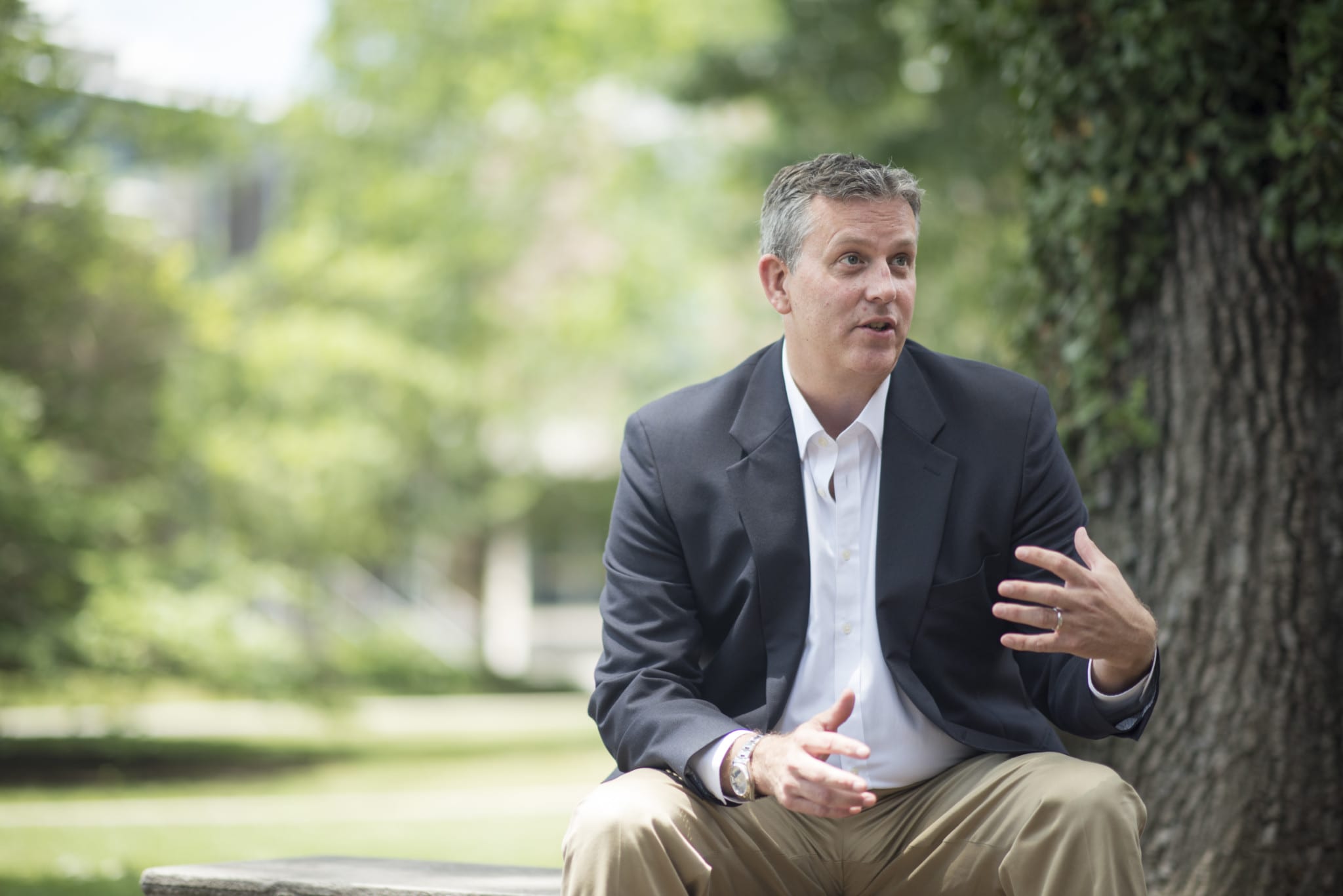
As a 2025-26 Old Dominion Research Professor in the Humanities Council, Eric Gregory (Religion), is focusing on an in-process book titled “The In-Gathering of Strangers: Global Justice and Political Theology,” which examines secular and religious perspectives on what human beings owe one another in a global age.
Tell us why you chose your current research topic.
I am not sure one ever fully knows why a particular research topic is chosen. In my case, it was perhaps overdetermined. Debates about a shared humanity and the scope of duties to strangers have sponsored a large literature in contemporary philosophy, including important work by several Princeton colleagues on cosmopolitanism and global justice. The same cannot be said for religious ethics despite its significance for the origins of humanitarianism and international law responding to human misery. So I wanted to see how Jewish and Christian traditions might contribute both to the practical and theoretical dimensions of these debates given their historical influence and ongoing role in public discussions of topics like immigration, poverty, and war. I regularly teach on those topics, so the book project emerged from these settings. Finally, while at some distance from my prior book on Augustine and democratic citizenship, I have come to see it as something of a companion piece moving primarily from a national context to a global one.
What do you hope that this research will add to your field?
I hope that this research will make contributions to intellectual history, political theology, and normative arguments about what we owe strangers in a global age at interpersonal and structural levels. This might trouble the ways that “religious” and “secular” are used in thinking about ethics and politics, even as it addresses the fraught nature of arguments defending “Christian” universalism against “Jewish” particularity. At the same time, especially given resurgent interest in religion and nationalism, I hope my defense of a version of liberal internationalism might respond to its critics on both the left and the right.
What’s one thing about your current project that you think would interest the public?
For better or worse, it is not hard to motivate interest in the role of religion in public life or the contested relationship between national belonging and global solidarity. Competing interpretations of the parable of the Good Samaritan, for example, have been invoked in recent public controversies. The story, conventionally read, teaches the importance of universal concern for any human being. But not everyone shares the same convictions about what human beings owe one another and how best to meet human need. Situating these interpretations in a broader setting could potentially be of interest to a wider public tempted by despair in our catastrophic circumstances of human suffering.
Tell us about your year as an Old Dominion Research Professor.
An “in-residence” leave is different for many reasons. I do not have to learn where to find books and good coffee. A break from the demands of teaching allows me to read more slowly and take advantage of Princeton’s intellectual community—especially across academic divisions—in ways that are difficult during a regular year, including scholarly exchanges with our many visitors. It also meant that I was able to see my two kids win their Princeton Middle School basketball championship!
Are there any memorable humanities events that you’ve attended this year?
A highlight of my Old Dominion year has been the weekly gatherings of the Society of Fellows. These interdisciplinary conversations with faculty and postdoctoral fellows give me hope for the future of the humanities.
Is there any other piece of your work that you’d like to highlight?
Apart from work on the book project, this sabbatical year allowed me to edit a special journal issue on Christianity and the liberal political tradition, including an article on “The Church of England as Liberal Christian Nationalism.” I published another journal article, “Christian Ethics and the Arc of the Universe: King, Augustine, and the Philosophy of History,” and a book review on the historiography of late antiquity. I also gave a talk at the National Press Club in Washington, D.C., on “Politics and the Problem of Dirty Hands.” Later this term, I will present at a conference at Oxford University on “Reimagining Humanism: Religious Humanisms as Frameworks for Building a Common Life in a Fractured World.” I am grateful to the Humanities Council for its support.