


After Concrete: Book Launch & Roundtable
Thu, 10/29 · 6:00 pm—7:30 pm · School of Architecture
School of Architecture


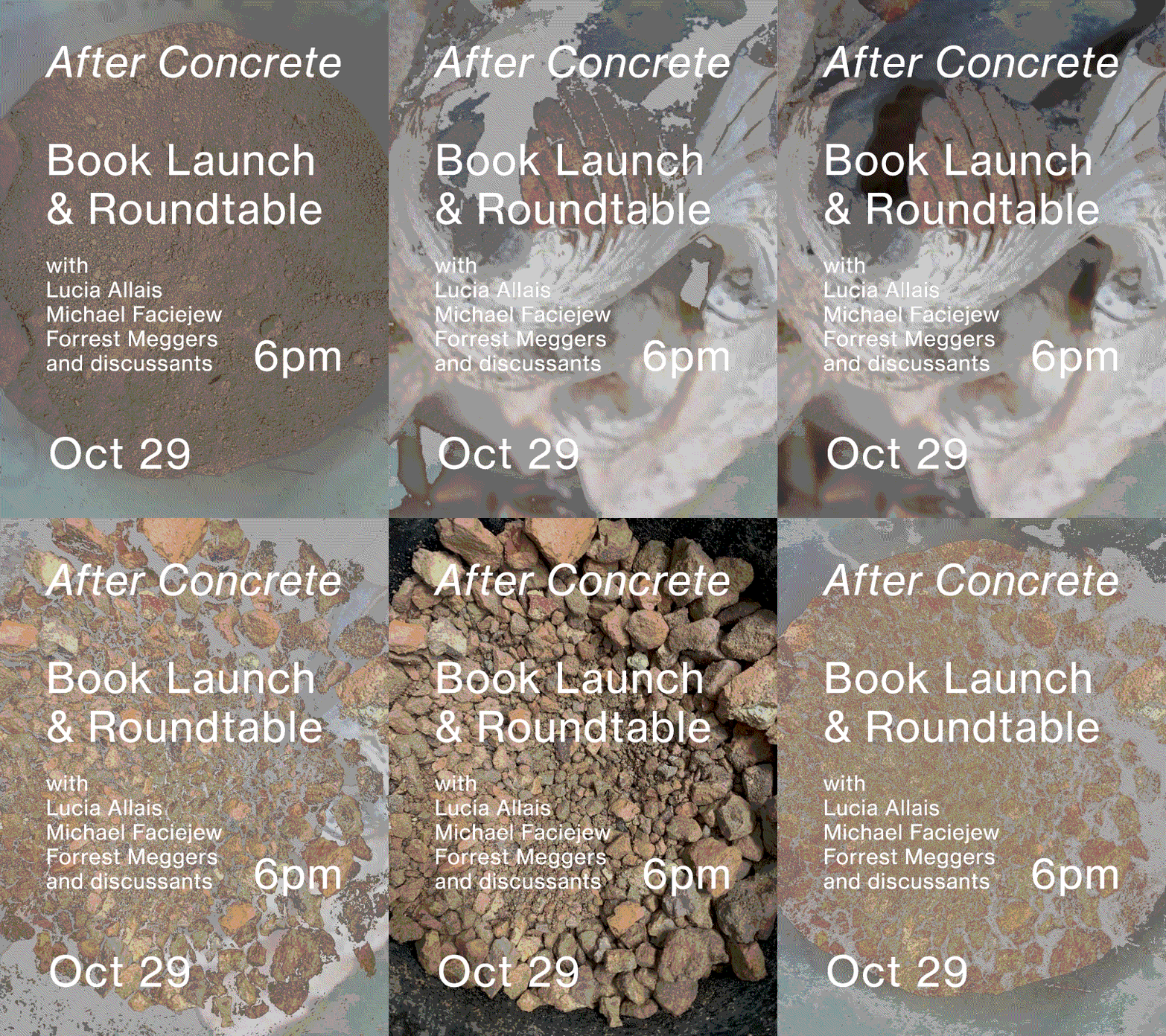
Concrete has been central to modern architecture for over a century, yet its environmental impacts raise urgent questions about its future. After Concrete: Rethinking the Dynamics of a Material (Birkhäuser, 2026) brings together essays by interdisciplinary scholars to examine concrete’s next chapter, investigating how its sustainability will draw both from innovative research and past solutions.
On October 29, 2026, at the Princeton University School of Architecture, the book’s three co-editors—Lucia Allais, Michael Faciejew, and Forrest Meggers—will discuss the volume and its proposition that addressing concrete’s environmental consequences requires a fundamental reconsideration of the assumptions and practices that shape how we build. Allais and Meggers previously convened at Princeton in 2020 for “Rethinking Concrete: Material Conventions in the Anthropocene,” a conference they co-organized to explore concrete, material culture, and the ecological conditions of the anthropocene and that laid groundwork for the book’s premise.
Joining the editors for a response and conversation will be Erin Besler, Billy Fleming, and After Concrete contributor Claire E. White. Together, the participants will consider how architecture might reimagine the material, technological, and historical conventions that have made concrete so indispensable. The event will conclude with an opportunity for the audience to ask questions.
About the Participants:
Lucia Allais is an architectural historian who works on institutions, technology and politics in the modern period and on the global stage. Her monograph Designs of Destruction (Chicago, 2018), followed the international redefinition of monuments in the 20th Century through episodes of planned destruction. She has earned a number of prizes and fellowships for this work and for essays on related themes. An Associate Professor of architecture and the Director of the Temple Hoyne Buell Center for the Study of American Architecture at Columbia University, she earned her BSE from Princeton, her MArch from Harvard, and her PhD from MIT. Before joining Columbia, Allais spent ten years at Princeton University, first as a Behrman-Cotsen Fellow in the Society of Fellows, then as an Assistant Professor, later Associate Professor with tenure, in the School of Architecture. Allais is a co-editor of Architecture and Land In and Out of the Americas (Buell, 2023), After Concrete: Rethinking the Dynamics of a Material (Birkhäuser, 2026), and the forthcoming Constructing Abundance. She is at work on two monographs: Topological Modernism, on the spatial treatment of “nature” in modernist complexes built on coastal and mountainous sites during three postwar economic miracles, and a book on buildings sponsored by the French state in late-to-postcolonial Senegal.
Michael Faciejew is an Assistant Professor at Dalhousie University. He researches the intersecting histories of architecture, media, technology, and colonialism since 1800. He is a co-editor of After Concrete: Rethinking the Dynamics of a Material (Birkhäuser, 2026) and is developing his first book project Knowledge Technics: Architecture, Information, and Imperial Worldmaking, which examines the architectural and imperial transformations that forged a modern culture of information in Europe between 1890 and 1960. He is the PI of the SSHRC-funded project “Terraqueous Architectures” and a co-editor of a special themed issue of Architecture Beyond Europe (ABE Journal) themed “Transactional Spaces: Currency in the Imperial Built Environment.” He is a founding Editorial Board Member of the new journal Wedge: Architectural Research, Pedagogy and Practice and the former Associate Editor (Reviews) of the Journal of Architectural Education (JAE). His writing has been published in Thresholds, Grey Room, Architectural Theory Review, and elsewhere. He was previously a postdoctoral associate at Yale University and has taught history and design at Princeton University, Pratt Institute, the University of Toronto, and Yale University.
Forrest Meggers is an Associate Professor in the School of Architecture and the Andlinger Center for Energy and the Environment at Princeton University. He is also a co-director of the Architecture and Engineering program and a co-chair of Princeton Sustainability Committee. He was previously an Assistant Professor in the Department of Architecture at the National University of Singapore, where he had traveled initially as a senior researcher and research module coordinator in the Singapore-ETH Centre’s Future Cities Laboratory. He has degrees in Mechanical Engineering (BSE), Environmental Engineering (MS), and Architecture (Dr sc.). He received his PhD in the Dept. of Architecture at the ETH Zurich. His fields of knowledge include building systems design and integration; sustainable systems; renewable energy; optimization of energy systems; exergy analysis; geothermal; seasonal energy storage; low temp hybrid solar; building materials; thermodynamics and heat transfer; and heat pumps. At Princeton, he founded and directs CHAOS (Cooling and Heating for Architecturally Optimized systems) Lab, where he and his research team investigate alternative thermal paradigms to engage architecture and maximize performance. Meggers is a co-editor of After Concrete: Rethinking the Dynamics of a Material (Birkhäuser, 2026).
Erin Besler is an Assistant Professor of Architecture at Princeton University School of Architecture. She was awarded the Founders Rome Prize in architecture from the American Academy in Rome, the Young Architects Prize by the Architectural League of New York, and was named to the USA 400 People Shaping Creative America by Wallpaper*. Previously Erin taught at the University of California Los Angeles in the department of Architecture and Urban Design (A.UD).She is a principal at Besler & Sons, an architecture and design practice based in New Jersey that she co-founded with Ian Besler in 2014. She holds a Bachelor of Arts from Yale University and a Master of Architecture with Distinction from the Southern California Institute of Architecture.
Billy Fleming is a leading voice on the role of design in responding to the climate crisis in our cities, communities, and landscapes. He is founding co-director of the Climate and Community Institute, a progressive think tank focused on climate and political economy, and Assistant Professor of Landscape Architecture at Temple University’s Tyler School of Art and Architecture in Philadelphia. Fleming was the inaugural Wilks Family Director of the Ian L. McHarg Center at the University of Pennsylvania and an urban policy advisor to the Obama administration. He is coeditor of Design with Nature Now (2019) and A Blueprint for Coastal Adaptation: Uniting Design, Economics, and Policy (2021).
Claire E. White, Associate Professor of Civil and Environmental Engineering and the Andlinger Center for Energy and the Environment, has been a faculty member at Princeton University since 2013. Her research focuses on understanding and optimizing engineering and environmental materials, with an emphasis on sustainable cements and materials for carbon capture, utilization and storage. Current projects include enhanced durability of sustainable cements, calcined clay-based alkali-activated cements, magnesium biocements for CO2 storage, low cost solid sorbents for CO2 capture, fundamentals of silicate mineral dissolution, and aqueous ion interactions within cement phases. She earned a Ph.D., Chemical and Biomolecular Engineering, a B.E., Civil Engineering, and a B.Sc., Physics from the University of Melbourne.