




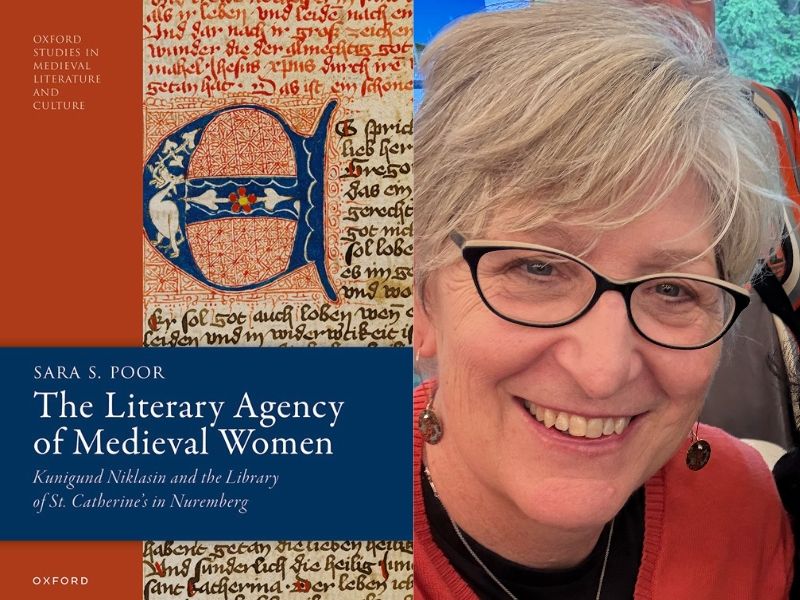
Sara S. Poor is a professor in the Department of German. She is affiliated faculty in the Department of Comparative Literature and the Program in Gender and Sexuality Studies and a member of the executive committee for the Humanities Council’s Program in Medieval Studies. Her book, “The Literary Agency of Medieval Women: Kunigund Niklasin and the Library of St. Catherine’s in Nuremberg” was published in April 2026 by Oxford University Press.
How did you get the idea for this project?
As I was doing research on the fifteenth-century German manuscripts transmitting a text known as the Sister Catherine Treatise, which is about a lay pious woman whose mystical experiences lead eventually to her teaching her teacher (her confessor) about God, I kept coming across the name of Kunigund Niklasin, the librarian and scribe of a Dominican convent in Nuremberg that had housed the largest convent library that we know of from the late middle ages.
It wasn’t until I was on a fellowship year at the National Humanities Center in North Carolina that I was able to look into her story more thoroughly and visit the archive in Nuremberg, where a large portion of this medieval library is still extant. The more I worked on what was going to be a chapter on Niklasin in a book about medieval women scribes, the more amazed I was at the amount of literary work she managed during her career at the convent, and eventually, I realized that I really needed a whole book to do her and her achievements justice.
How has your project developed or changed throughout the research and writing process?
Originally, I was interested in the stories that medieval religious women told each other through books, stories about smart, gifted, and clever women who were able to best preachers in debates about the experience of the divine. These women were not saintly models. Rather, they were from more ordinary walks of life (e.g., a miller’s wife, a milkmaid, a beguine). But as I worked on the material from the Nuremberg convent library, my interest became more historical. There was so much evidence of literate activity (or as I call it in the title, literary agency) that had been overlooked in the wider circles of medieval studies. So the goal of the book became the documentation and exploration of that agency and its impact.
What questions for future investigation has the project sparked?
I continue to be motivated by questions about what medieval women wrote and read, how that material was transmitted, and what all of that can tell us about women’s history. My current obsession is with another nun from St. Catherine’s who brought 24 books with her when she entered the convent as widow. My question for these books: what can they tell us about the intellectual life of this fifteenth-century woman?
Why should people read this book?
There tends to be an assumption that women were oppressed and silenced under medieval Christianity. But reading about Niklasin and the vibrant literary culture she oversaw as convent librarian will help people to reconsider, if not discard this cliché once and for all.
Learn more about other publications by Princeton University faculty in the humanities by exploring our Faculty Bookshelf.